
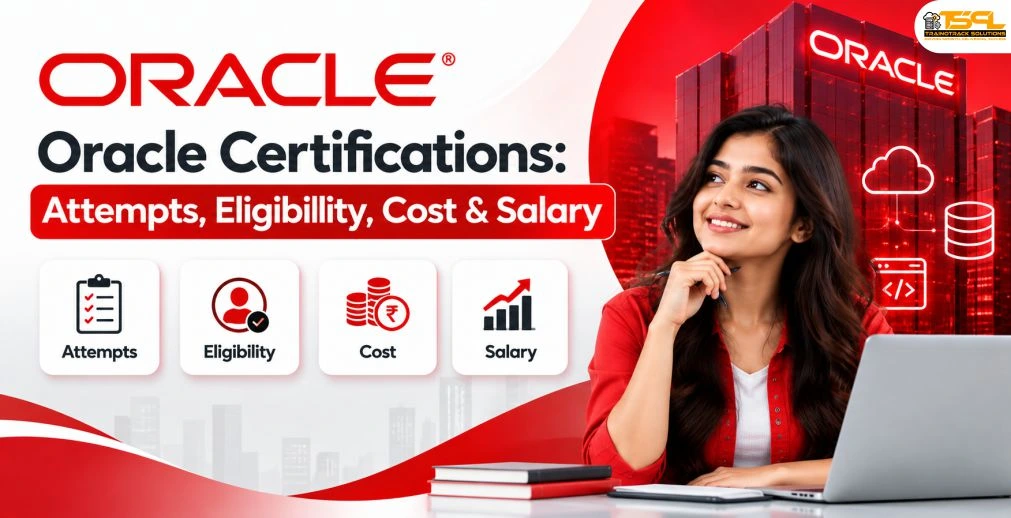
Oracle certifications are widely recognized credentials for IT professionals working with databases, cloud infrastructure, Java, enterprise applications, and other Oracle technologies. As organizations continue to use Oracle platforms for cloud computing, data management, application development, and enterprise operations, certification can help professionals demonstrate their knowledge of specific Oracle technologies and job roles.
However, choosing an Oracle certification involves more than selecting an exam. Navigating the process requires understanding tier structures, exam patterns (question counts, durations, and passing scores), strict attempt-and-retake policies, MyLearn registration mechanics, and exact cost structures.
Understanding the complete Oracle certification process helps candidates select a suitable certification, prepare effectively, and align their certification journey with industry hiring standards.
What Are the Oracle Certifications?
Oracle certifications are role-based IT credentials delivered directly via Oracle MyLearn. Standard exams feature 40 to 70 multiple-choice and multi-select questions, last 60 to 90 minutes, and require a passing score between 60% and 68%. They cost approximately ₹20,567 INR + 18% GST per attempt.
Oracle organizes certifications into distinct progressive tiers:
- Oracle Certified Foundations Associate: Focuses on fundamental architectural concepts, core services, and terminology. Suitable for beginners, non-technical professionals, and students.
- Oracle Certified Associate (OCA): Validates foundational hands-on administration, routine product maintenance, and role-based tasks.
- Oracle Certified Professional (OCP): Demonstrates deep technical and architectural expertise, advanced configuration, troubleshooting, and enterprise-scale deployment capabilities.
- Specialist / Specialist Implementation: Validates technical mastery in delivering specific implementation solutions, migrations, or integrations (such as Oracle Fusion Cloud ERP/HCM modules).
Oracle Certification Eligibility
Oracle operates on an open-access testing model with no rigid degree cutoffs, but candidates must satisfy specific age, identification, and technical prerequisite rules before taking an exam:
- Educational Qualifications & Degrees: There are no mandatory academic degree requirements (e.g., B.Tech, MCA, or computer science degrees) to appear for Oracle exams. Non-technical graduates and self-taught developers are fully eligible.
- Identity Verification Requirements: Candidates must provide one valid, government-issued photo identification card (such as a passport, Aadhaar card, or driver's license). The legal name registered on your Oracle Single Sign-On (SSO) profile must match the ID character-for-character, or proctors will deny exam entry.
- Track Progression & Technical Prerequisites:
- Foundations Associate: Zero prerequisites. Open directly to any registered candidate.
- Associate (OCA): Open-entry. Passing a foundation-level exam is recommended but not a mandatory prerequisite.
- Professional (OCP): Prerequisite rules depend on the technology stack. For OCI Cloud Architect tracks, candidates can challenge the professional level directly. However, for the Oracle Database Administration (DBA) track, earning the full OCP designation requires passing both sequential exams (Exam I: 1Z0-082 and Exam II: 1Z0-083).
- Specialist / Delta Recertifications: Requires an active base credential. Only candidates with a credential nearing its 18-month renewal deadline are eligible to take low-cost delta renewal assessments.
How to Register for the Oracle Certification Exam?
The entire registration and exam-taking process is managed inside MyLearn:
- Sign In with Oracle SSO: Log in using your Oracle Single Sign-On account. Ensure your profile name matches your government-issued ID (passport, Aadhaar Card, or driver's license).
- Select Certification: Search your target exam code (e.g., 1Z0-1085) to view domain weightings, exam blueprints, and recommended learning assets.
- Redeem Exam Attempt: Apply an active Oracle exam attempt from your My Exam Wallet or check out via credit card.
- Schedule Your Online Slot: Remote proctoring provides 24/7 testing availability across all international time zones.
- Rescheduling / Cancellation: Changes must be submitted at least 24 hours prior to the scheduled appointment window to avoid forfeiting your attempt.
- Exam-Day Execution: Sign in 30 minutes before launch check-in. You will be required to take photos of your government ID and complete a 360-degree room sweep confirming a clean workspace (no dual monitors, smartwatches, or physical paper).
How Many Attempts Do You Get for an Oracle Certification?
Candidates may sit for a failed Oracle certification exam a maximum of four times within a 12-month rolling period, subject to a mandatory 5-day waiting period between consecutive attempts.
Key rules governing attempts include:
- No Automatic Free Retakes: A standard single-exam purchase covers exactly one sitting. Unsuccessful attempts require purchasing a new attempt or using a subscription credit.
- Passed Exams Cannot Be Repeated: Once an exam version is passed, candidates cannot retake the same exam title unless a new major revision or Delta version is officially released.
- Single Testing Identity Policy: Creating secondary Oracle accounts to bypass retake wait periods or attempt caps constitutes a direct violation of Oracle’s testing agreement and can result in credential revocation.
- Strict Scoring Mechanics: On multi-select questions (e.g., "Choose 3 correct answers"), Oracle rarely awards partial credit. Selecting two correct answers and one incorrect answer typically yields zero credit for that item.
How Much Does an Oracle Certification Exam Cost?
A standard Oracle certification exam attempt costs ₹20,567 INR; professionals use official Oracle exam vouchers to register exam slots at lower prices.
| Certification | Estimated Cost in India (INR) | Pricing Details |
|---|---|---|
| OCI & AI Foundations Associate | ₹7,975 + GST | Frequently offered at no cost during Oracle University promotions |
| Associate / OCP Standard Exam | ₹20,567 + 18% GST | Standard fee per attempt for OCI, Java SE, and database tracks |
| Delta / Recertification Exam | ₹10,490 + 18% GST | Streamlined assessments designed to renew cloud SaaS credentials |
| Exam Retake Sitting | ₹20,567 + 18% GST | Retakes are billed at the full single-attempt rate. |
| Unlimited Learning Subscription | ₹419,000+/yr + GST | Enterprise access: complete video library + 3 exam attempts/year |
Oracle Certified Professional Salary
Certification validates competence, but real compensation is determined by real-world system ownership, architectural skill, and regional market demand.
| Job Roles | Average India Salary | Average US Salary |
|---|---|---|
| Oracle Database Administrator (DBA) | ₹850,000 – ₹1,800,000 | $105,000 – $135,000 |
| Cloud Infrastructure Engineer | ₹900,000 – ₹2,200,000 | $115,000 – $145,000 |
| Cloud Solutions Architect | ₹20,00,000 – ₹38,00,000+ | $132,500 – $176,500+ |
| Java Enterprise Developer | ₹750,000 – ₹16,50,000 | $100,000 – $130,000 |
| Oracle Cloud Apps Consultant | ₹10,00,000 – ₹24,00,000 | $110,000 – $150,000 |
Conclusion
Oracle certifications provide a clear, standardized framework for IT professionals looking to validate technical proficiencies across cloud engineering, database administration, software architecture, and enterprise SaaS solutions.
By understanding the MyLearn ecosystem, adhering to attempt and retake policies, budgeting for localized exam fees (approx. ₹20,567 INR + GST), and reinforcing theory with practical, hands-on labs, candidates can earn credentials that carry genuine weight in today's competitive global job market.














Leave a Comment