
Organizations want professionals who understand risk, governance, security, compliance, and business impact. A degree may open the door, but it is no longer enough on its own. Employers now look for proof that you can manage, audit, and secure complex IT environments in real-world situations. This is why ISACA certifications have become an important differentiator for a serious IT and cybersecurity career.
In previous years, companies were ready to train their own professionals in the governance and risk functions. That flexibility will be significantly less by 2026. Business leaders expect professionals to have a certain level of framework knowledge, decision-making skills, and compliance intelligence. ISACA certifications are the recognized indicator of those skills.
ISACA certificates are not just about learning tools or technologies in isolation. They show that you can align IT with business goals, manage risks, follow regulations, and protect organizational value. Whether you are an IT auditor, security professional, risk manager, or an aspiring leader, the right certification can directly impact your job role, salary growth, and long-term career stability.
List of Top 5 ISACA Certifications
ISACA certifications are respected worldwide, as they are focused on real-world models, governance structures, and making decisions, rather than technical execution alone. In 2026, organizations are seeking more individuals who can effectively serve as translators between the technology and business sides of the house. That is why ISACA credentials frequently rank among the top-earning, most stable IT certifications. When leveraged in the right manner, the undermentioned certifications are the backbone of your career road map in IT for 2026.
Certified Information Systems Auditor (CISA)
CISA is the best-known and widely recognized certification for professionals working in IT auditing, assurance, and control. It demonstrates that you can identify risks, apply controls, and maintain compliance in enterprise IT systems. With mounting regulatory pressure in all industries, organizations are more dependent than ever on certified auditors to mitigate operational and financial risk.
CISA professionals usually advance into positions such as IT auditor, internal auditor, compliance analyst, or audit manager. CISA will continue to be an essential credential for those in finance, healthcare, government, and large enterprises where compliance is a must.
What is the eligibility criteria for CISA certification?
Candidates can appear without prerequisites, but certification requires 5 years of experience in IT audit, control, assurance, or security. Experience waivers based on education or certifications are available.
Exam Benefits:
This exam tests your understanding of IT auditing processes, governance, risk management, and protection of information assets. Strong conceptual clarity and structured preparation are essential.
- It opens doors to compliance and audit roles.
- It improves long-term career stability.
- It increases credibility with regulators and management.
Certified Information Security Manager (CISM)
CISM is tailored for those with experience in security management or who are looking to transition from security practitioner to manager. This certificate focuses much more on governance, risk management, incident response, and strategic security planning rather than tools. Therefore, it is still among the most lucrative ISACA certifications for 2026.
A CISM certificate holder is a respected individual in an organization because he/she understands how to relate or bridge security risks to business risks. Some typical job titles you can get include Information Security Manager, Security Program Manager, GRC Manager, CISO-Track Roles, and many more.
What is the eligibility criteria for CISM certification?
No eligibility is required to attempt the CISM exam. The certificate requires 5 years of information security experience, including at least 3 years in security management or leadership roles.
Exam Benefits:
The exam focuses on security governance, risk management, program development, and incident management. A business-oriented mindset is crucial.
- It proves leadership-level security expertise.
- It helps professionals transition into managerial roles.
- It significantly improves salary potential.
- It strengthens strategic decision-making skills.
Certified in Risk and Information Systems Control (CRISC)
CRISC is designed specifically for IT risk management and control design professionals. Certified individuals are sought after in 2026, as these organizations are encountering increasing cyber threats, regulatory requirements, and operational risks.
This credential demonstrates your expertise in identifying, evaluating, and responding to IT risks in a way that is consistent with business goals. CRISC is an ideal certification for risk management professionals, governance, and compliance.
What is The Eligibility Criteria for CRISC Certification?
There is no prerequisite to attempt the exam, but certification requires 3 years of work experience in IT risk management across at least two CRISC domains.
Exam Benefits:
The exam tests your knowledge of risk identification, assessment, response, and monitoring. Practical understanding of risk frameworks is essential.
- It supports careers in GRC and enterprise risk roles.
- It increases demand in regulated industries.
- It enhances professional credibility.
Advanced in AI Audit (AAIA)
AAIA is amongst the most recent and progressive ISACA certifications. As AI is ingrained so deeply in business processes, businesses are starting to worry more about AI risk, ethics, transparency, and compliance. AAIA certification is designed to manage this gap.
This certification is developed for auditors to audit AI systems, grasp algorithmic risk and AI model governance, as well as consider regulatory expectations around artificial intelligence. This credential is a must-have skill for professionals operating in the AI, compliance, and governance space.
What is The Eligibility Criteria for AAIA Certification?
No formal eligibility criteria exist for this certification. Designed for professionals with prior experience in audit, risk, compliance, data governance, or AI-related roles.
Exam Benefits:
The exam tests your understanding of AI concepts, audit methodologies, governance frameworks, and risk assessment for AI-driven systems.
- It positions you at the forefront of AI governance.
- It supports careers in AI audit and compliance.
- It increases relevance in emerging regulatory landscapes.
- It strengthens future-proof career prospects.
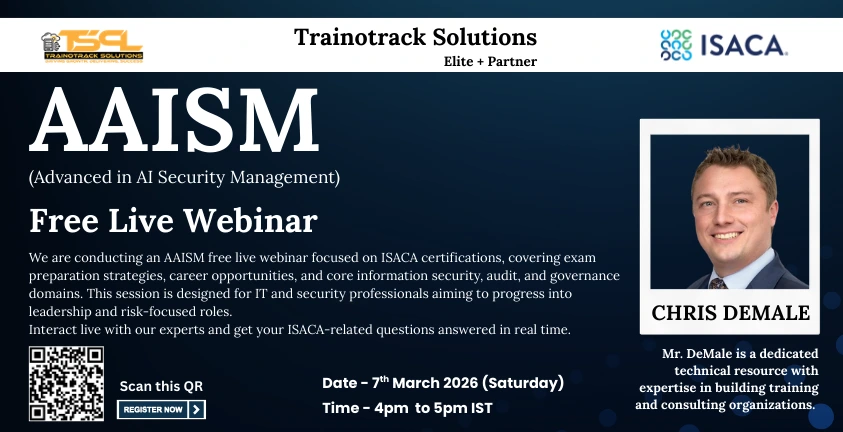
Advanced in AI Security Management (AAISM)
AAISM deals with securing AI systems and the associated risks of AI-based technologies. With increased adoption of AI, there is an increasing concern related to data poisoning, model theft, adversarial attacks, and abuse of AI systems. AAISM certification proves you have the skills needed to address these complex security issues.
This is the perfect credential for seasoned security practitioners who are looking to expand their expertise into AI Security Governance and Risk space beyond traditional infrastructure security.
What is The Eligibility Criteria for AAISM Certification?
No mandatory eligibility to attempt the AAISM exam. It is intended for experienced cybersecurity or risk professionals with exposure to AI systems and security governance.
Exam Benefits:
The exam evaluates your understanding of AI security risks, governance models, threat scenarios, and mitigation strategies.
- It validates advanced AI security management skills.
- It supports leadership roles in emerging security domains.
- It increases demand in AI-driven organizations.
- It enhances long-term career growth.
ISACA Certifications Cost in India
| Certifications | Exam Fees |
|---|---|
| Certified Information Systems Auditor - CISA | ₹67,640/- |
| Certified Information Security Manager - CISM | ₹67,640/- |
| Certified in Risk and Information Systems Control - CRISC | ₹67,640/- |
| Advanced in AI Audit - AAIA | ₹53,311/- |
| Advanced in AI Security Management - AAISM | ₹53,311/- |
If you are planning to take one of these certifications, you must use our ISACA certification vouchers to book your exam slot at a lower than market price with zero hassle.
Certified Professionals Salary and Experience Outlook
To understand the real impact of ISACA certifications, it is important to evaluate salary trends alongside experience requirements. Below is an approximate overview of how certifications align with experience levels and earning potential in 2026.
| Certifications | Experience Level | Designations | Indian/Global Salary |
|---|---|---|---|
| Certified Information Systems Auditor - CISA | 2–5 Years | IT Auditor, Compliance Analyst, Audit Consultant | ₹8L–15 LPA ($90,000 – $120,000) |
| Certified Information Security Manager - CISM | 6+ Years | Information Security Manager, GRC Manager, CISO Track | ₹25L–45 LPA ($145,000 – $195,000) |
| Certified in Risk and Information Systems Control - CRISC | 4–8 Years | Risk Manager, GRC Consultant, Risk Analyst | ₹18–30 LPA ($120,000 – $165,000) |
| Advanced in AI Audit - AAIA | 5–8 Years | AI Auditor, AI Governance Consultant, Risk Advisor | ₹20–35 LPA ($130,000 – $175,000) |
| Advanced in AI Security Management - AAISM | 6–10 Years | AI Security Manager, Security Architect, AI Risk Lead | ₹25–40 LPA ($140,000 – $185,000) |
Conclusion
Earning ISACA certifications in 2026 is a strategic move to future-proof your career in IT governance, risk, and security. Whether you are aiming for a foundational auditor role with CISA, targeting a leadership position with CISM, or pioneering AI compliance with AAIA, these credentials prove you have the critical blend of technical insight and business acumen that modern enterprises demand.













Leave a Comment